 4.9
4.9


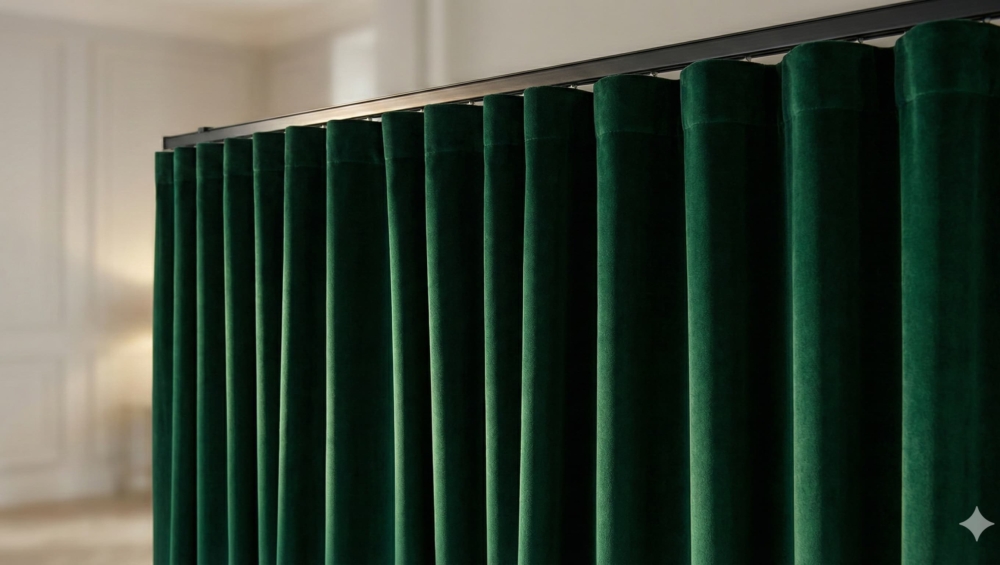
We have all seen it. You walk into a room, and the curtains look… sad. They cover the window, sure, but they hang perfectly flat, looking more like a bedsheet tacked to the wall than a luxurious window treatment.
Why does this happen? Usually, the homeowner made a fundamental math error. They measured the window width and bought exactly that amount of fabric.
In reality, “Ready-Made” curtains does not mean you just buy one pack and slap it up. To achieve that designer look where the fabric folds and waves beautifully, you must understand the concept of “Fullness.” Basically, you need way more fabric than you think.
Stop settling for flat curtains. Therefore, we created this guide to explain the secret math behind the perfect wave. We will teach you how to calculate optimized fullness ratios so your ready-made curtains look custom-made.
Ready to do some simple math? Let’s measure up.
Understanding Fullness Ratios and Measuring for Ready-Made Curtains
The “Flat Sheet” Trap: Why Width is Not Enough
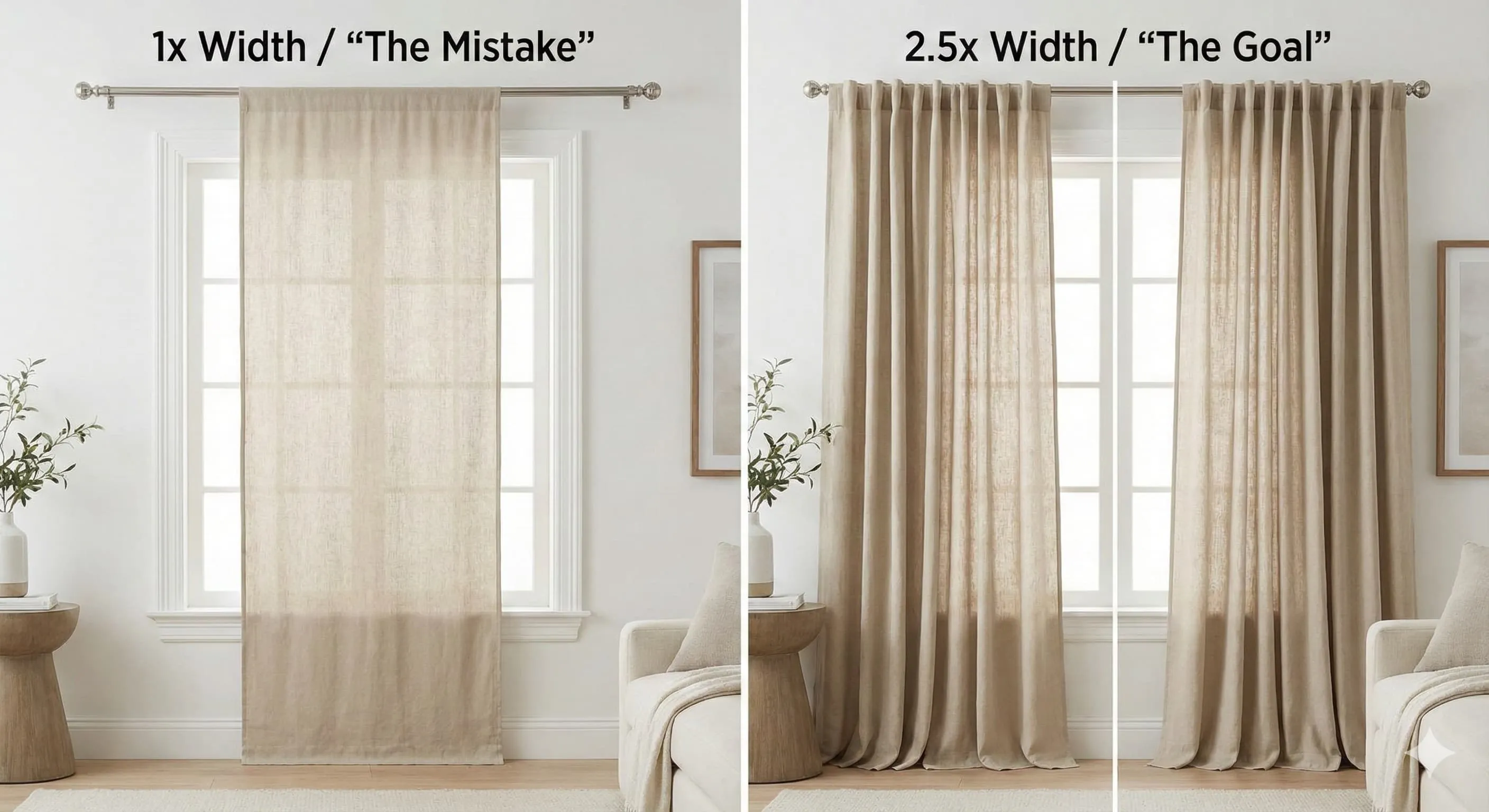
First, let’s identify the mistake. If your window measures 200cm wide, and you buy a pair of curtains that equals 200cm wide, you have a problem.
When you close these curtains, they will stretch completely tight. They will lose all texture, depth, and pleating. Consequently, the room looks cheap and unfinished. This is the result of insufficient fabric width.
To fix this, you must change your mindset. You are not measuring to cover the window; you are measuring to pleat the window. You need extra fabric to accommodate the curves and folds that give drapery its elegance.
The Magic Formula: The 2x and 2.5x Rules
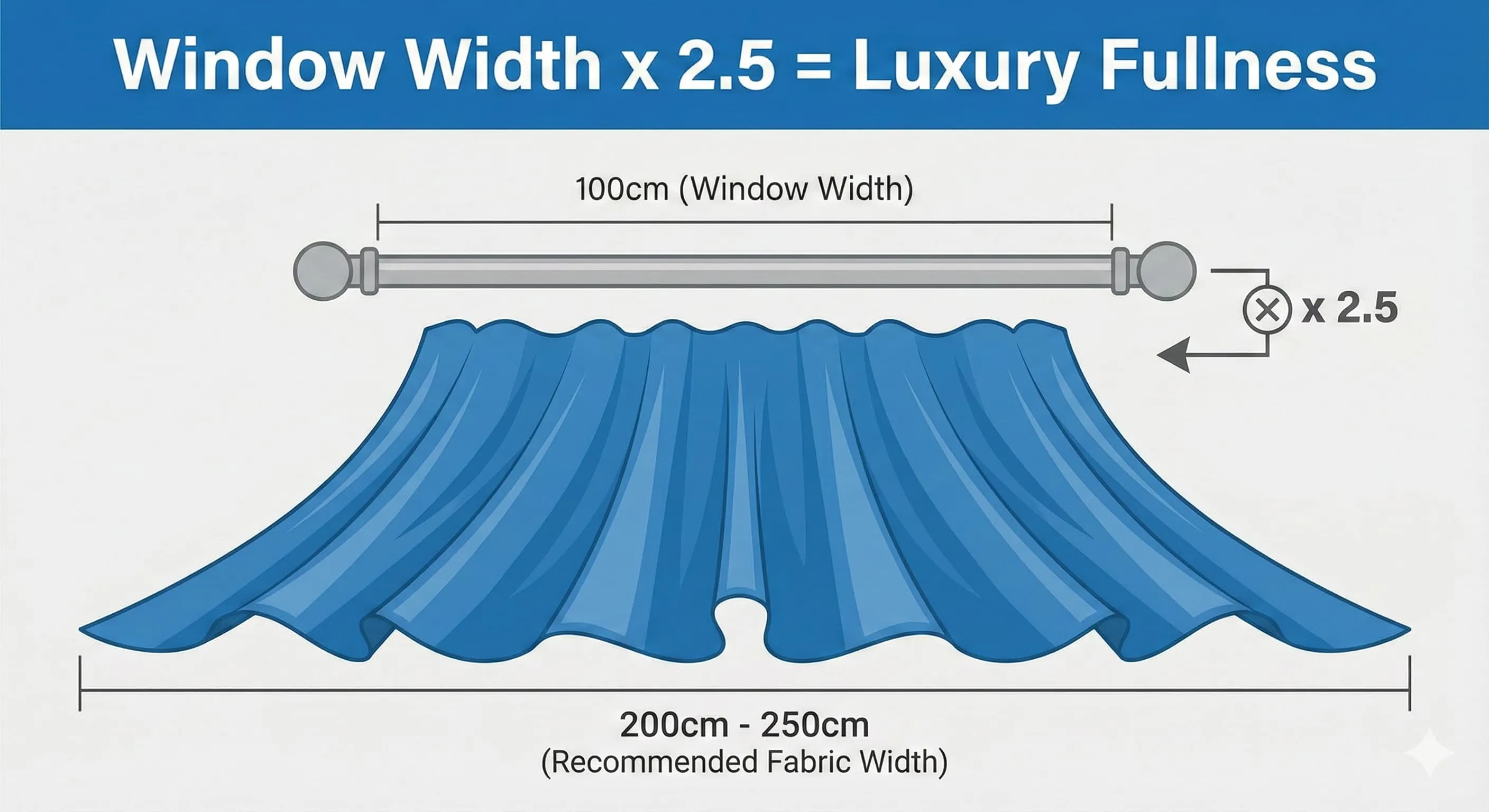
So, how much fabric do you actually need? Fortunately, the math remains simple. Interior designers generally stick to two golden rules of fullness.
1. Standard Fullness (2x Ratio)
This is the minimum requirement for a decent look. Simply, take your window width (or rod width) and multiply it by 2.
-
The Math: If your window is 100cm wide, you need 200cm of total curtain width.
-
The Result: This provides gentle waves when closed and a modest stack when open.
2. Deluxe Fullness (2.5x to 3x Ratio)
If you want true luxury, you aim higher. Multiply your width by 2.5 or even 3.
-
The Math: If your window is 100cm wide, you purchase 250cm to 300cm of fabric.
-
The Result: This creates a deep, voluminous look. Even when you pull the curtains shut, the fabric retains its shape and creates a rich, undulating ripple. This is the secret to the “hotel vibe.”
Practical Example: Buying Ready-Made Panels
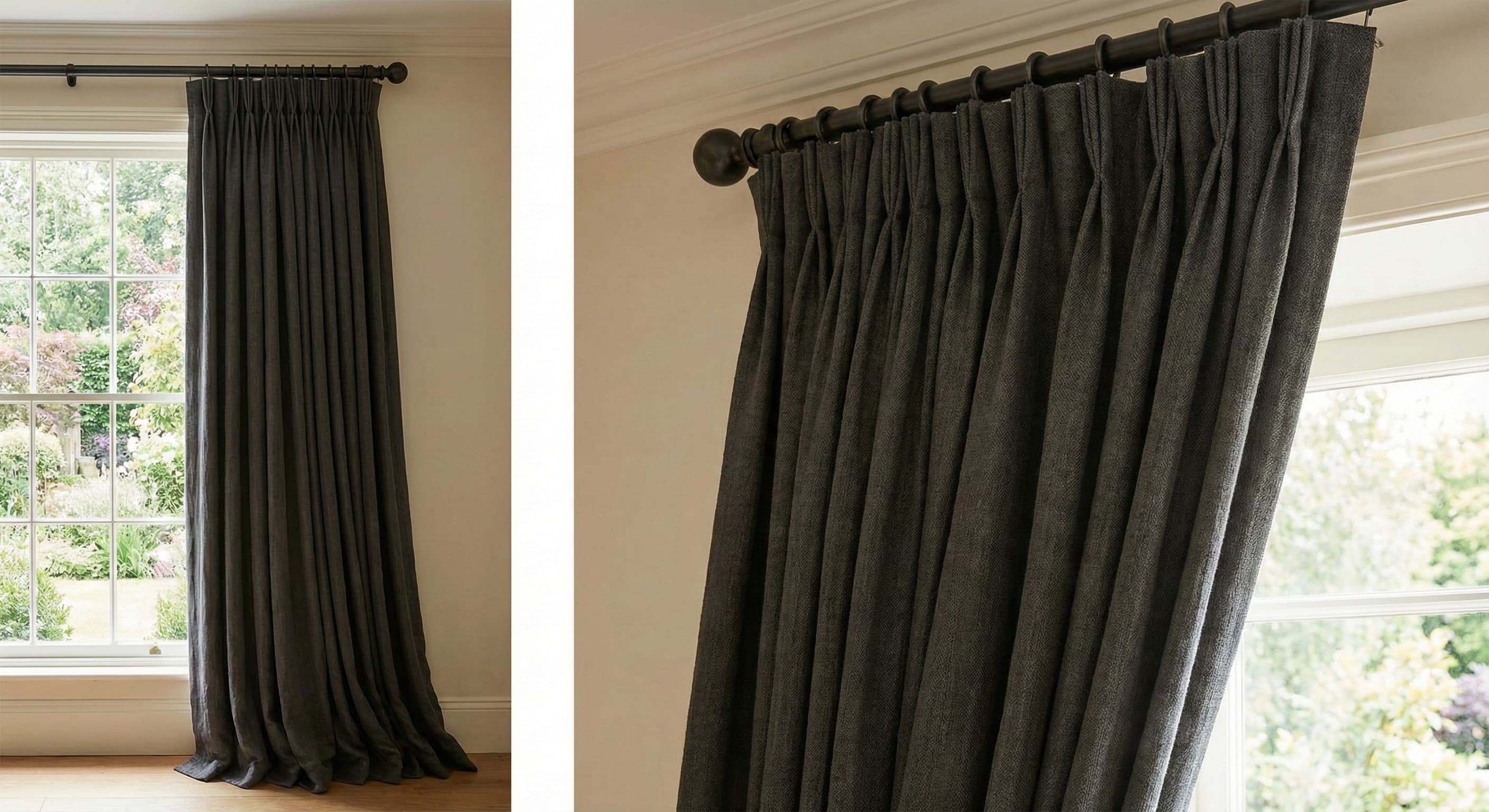
Let’s apply this to a real shopping trip. Suppose you find a beautiful ready-made panel that is 140cm wide. You have a 200cm wide window.
-
The Amateur Move: You buy 2 panels (Total 280cm).
-
Calculation: 280cm ÷ 200cm = 1.4x Ratio.
-
Verdict: Too flat. It will look skimpy.
-
-
The Pro Move: You buy 4 panels (Total 560cm).
-
Calculation: 560cm ÷ 200cm = 2.8x Ratio.
-
Verdict: Perfect. You sew or hang two panels on each side. Now, you possess abundant volume and deep folds.
-
Conclusion: More is More
Ultimately, when it comes to curtains, generosity pays off. Don’t skimp on the panels. Next time you shop for ready-made drapes, bring your calculator.
By applying the fullness ratio, you transform a budget-friendly purchase into a high-end design statement. Buy the extra panel. Your windows will thank you.