 English
 Bahasa Indonesia

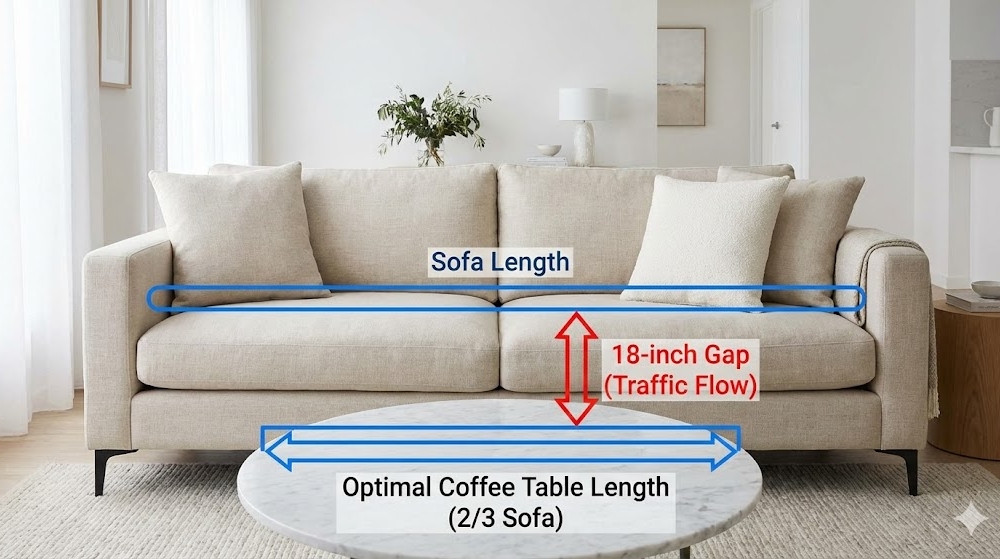
You finally bought that gorgeous sofa. However, you now face the most common design pitfall: choosing a coffee table that looks like a tiny island in a giant sea. In reality, a coffee table acts as the anchor of your seating arrangement. Consequently, if you get the proportions wrong, the entire room feels “off,” regardless of how much you spent on the furniture.
Mastering the Spatial Dynamics of your living room requires more than just an eye for color. You must apply the “Golden Ratio” of interior design to ensure your room functions as well as it looks. Therefore, we created this guide to break down the cold, hard math of coffee table styling.
Ready to turn your living room into a masterclass in balance? Let’s grab the tape measure.
The Golden Ratio of Living Rooms
1. The 2/3 Rule: Mastering the Length
First, you must address the scale of the table relative to your sofa. Specifically, a coffee table that exceeds the length of your sofa looks overwhelming, while a table that is too short creates a visual void.
Ideally, you should choose a table that measures approximately two-thirds the length of your sofa. For example, if you own a 240cm sofa, your coffee table should land somewhere around the 160cm mark. By following this ratio, you ensure the table feels substantial enough to ground the space without crowding the ends of the seating area. Furthermore, this proportion creates a pleasing horizontal symmetry that the human eye naturally craves.
2. The 18-Inch Law: Solving for Ergonomics

Next, we must discuss the “Clearance Zone.” This is where most homeowners fail. Typically, people place their tables either too far away to reach their drinks or too close to walk past comfortably.
In the world of ergonomics, the magic number is 18 inches (approx. 45cm).
Consequently, you should maintain exactly 18 inches of space between the edge of the sofa and the edge of the table. Why? This distance provides enough legroom for a tall guest to sit comfortably, yet it remains close enough for you to set down a glass of water without leaning forward. In addition, ensure the height of the table sits within 1 to 2 inches of your sofa’s seat height. Ultimately, matching the heights prevents you from reaching “up” or “down” too far, preserving the flow of the room.
3. Shape Selection: Managing Traffic Flow
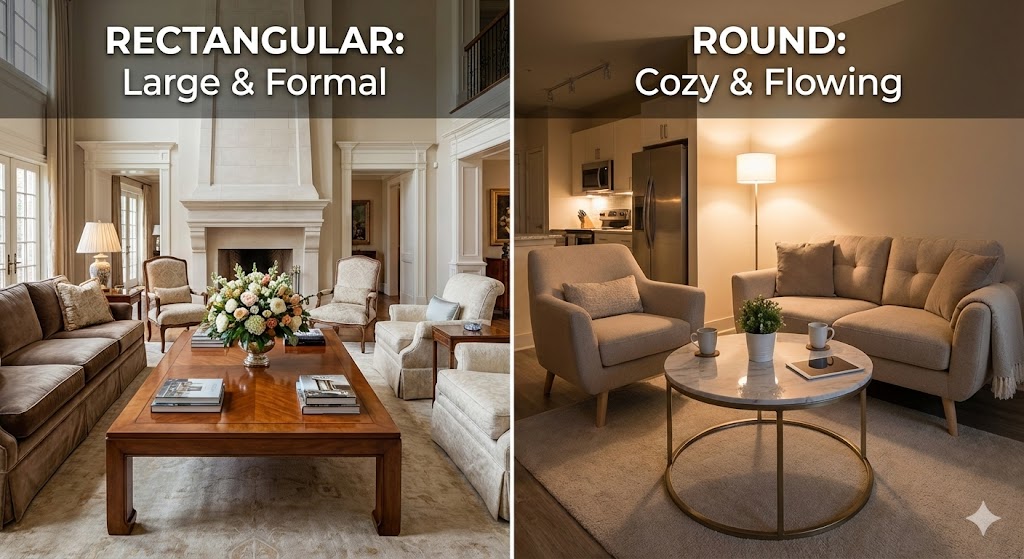
Now, you must decide on the silhouette. Actually, the shape of your table dictates how people move through your home.
-
The Rectangular Coffee Table: Use this shape if you have a standard, long sofa or a large L-shaped sectional. Because it mimics the long lines of the seating, it provides a surface for everyone on the couch. However, avoid sharp corners if you live in a tight space with heavy foot traffic.
-
The Round or Oval Table: On the contrary, choose a round table if your room feels “boxy” or if you have a small, square seating area. Specifically, round tables soften the hard edges of a room and allow for easier “curving” traffic patterns. Therefore, if you have toddlers running around, a round table serves as a vital safety feature.
4. Visual Weight: The Final Layer
Finally, consider the “Visual Weight” of the material. If your sofa features heavy upholstery and sits low to the ground, choose a coffee table with slender legs or a glass top. Conversely, if your sofa sits on high, thin legs, anchor the space with a solid block or a heavy wood plinth. By balancing the “heaviness” of the pieces, you create a room that feels grounded rather than cluttered.
Conclusion: Trust the Math, Enjoy the Style
Decorating a home involves a lot of intuition, but layout relies on science. Ultimately, when you respect the 2/3 rule and the 18-inch clearance, the room just “works.”
So, stop guessing and start measuring. Your perfect living room layout is just a few inches away.




1 Comment
I like the design!